

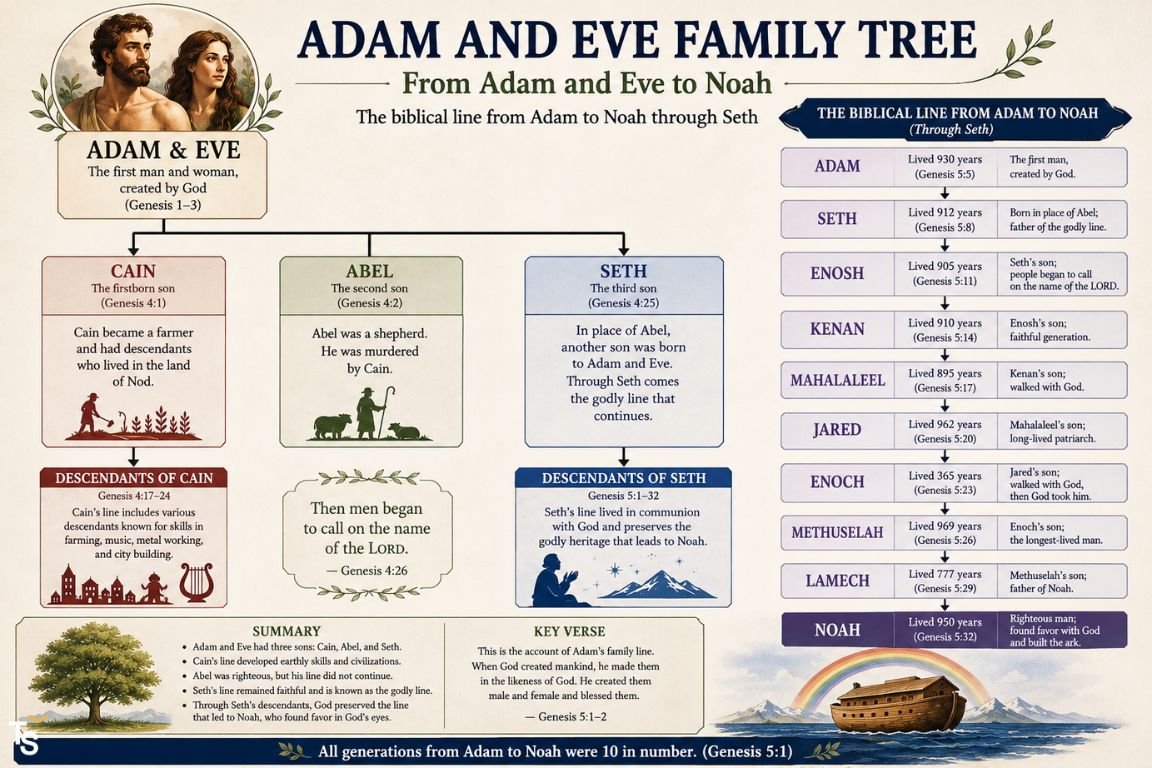
The Adam and Eve family tree is one of the most discussed genealogies in the Bible. According to the Book of Genesis, Adam and Eve are presented as the first human couple, and their family story begins with their sons Cain and Abel. After Abel’s death, Genesis introduces Seth, another son through whom the Bible traces a detailed family line leading eventually to Noah.
The biblical account does not provide a complete list of every child Adam and Eve had. Instead, it names several important children and then states that Adam had additional sons and daughters. Genesis 5 provides a genealogy from Adam through Seth and his descendants, eventually reaching Noah.
Understanding the Adam and Eve family tree therefore requires separating the people specifically named in Genesis from unnamed family members and from traditions that developed outside the biblical text.
Adam and Eve Family Tree at a Glance
The central family line described in Genesis can be simplified as follows:
Adam + Eve
├── Cain
├── Abel
├── Seth
│ └── Enosh
│ └── Kenan (Cainan)
│ └── Mahalalel
│ └── Jared
│ └── Enoch
│ └── Methuselah
│ └── Lamech
│ └── Noah
└── Other sons and daughters
This is the principal male-line genealogy recorded in Genesis 5. The text names Seth as the son through whom this particular genealogy is developed, while also saying that Adam had other sons and daughters.
Who Were Adam and Eve?
In Genesis, Adam and Eve occupy the beginning of the biblical human story. Genesis describes the creation of humanity as male and female and subsequently presents Eve as Adam’s wife. Their family becomes the starting point for the genealogical accounts that follow.
The early chapters of Genesis focus less on providing a conventional modern family record and more on explaining the beginnings of humanity, sin, family conflict, work, death, and the continuation of human life.
Because the account is ancient religious literature rather than a modern genealogical record, it does not provide surnames, birth certificates, exact locations, or a complete list of family members.
Cain: Adam and Eve’s First Named Son
Cain is the first child of Adam and Eve named in Genesis. He becomes a farmer, while his brother Abel is described as a keeper of sheep.
The story of Cain and Abel is one of the most significant family narratives in Genesis. Cain becomes angry after God accepts Abel’s offering but does not accept Cain’s in the same way. Cain ultimately kills Abel, making the brothers’ conflict a defining event in the early biblical story.
Genesis then describes Cain’s descendants separately from the genealogy that later runs through Seth. This distinction is important when looking at the Adam and Eve family tree because Cain’s line and Seth’s line are presented as different branches.
Genesis 4 records several descendants of Cain, including Enoch, Irad, Mehujael, Methushael, and Lamech. Lamech’s children include Jabal, Jubal, Tubal-Cain, and a daughter named Naamah.
This branch should not be confused with the later genealogy from Seth to Noah. Some names appear similar or identical across the two genealogical passages, but the biblical text presents them in different family lines.
Abel: The Son Whose Line Does Not Continue
Abel is Adam and Eve’s second named son in Genesis. He works as a shepherd and is killed by his brother Cain.
Unlike Cain and Seth, Abel does not have a genealogy in Genesis. The biblical narrative ends his family line with his death, so there are no named descendants of Abel in the genealogical record.
Abel’s importance in the family tree is therefore not based on descendants but on his role in the story of Cain, the first brothers described in Genesis.
Seth: The Main Genealogical Line
Seth is especially important when examining the biblical genealogy of Adam. Genesis 5 begins a formal family line with Adam and identifies Seth as the son through whom the genealogy proceeds.
Genesis states that Adam was 130 years old when Seth was born. It then says Adam lived another 800 years and had other sons and daughters. According to the same passage, Adam lived 930 years in total.
Seth’s importance becomes clearer because Genesis continues directly from him to Enosh and then through several generations to Noah.
The genealogy is therefore commonly represented as:
Adam → Seth → Enosh → Kenan → Mahalalel → Jared → Enoch → Methuselah → Lamech → Noah
Enosh and the Next Generations
Seth’s son is named Enosh. Genesis says Seth was 105 years old when Enosh was born and subsequently lived another 807 years, having other sons and daughters.
Enosh is followed by Kenan, also called Cainan in some English Bible translations. Genesis says Enosh was 90 when Kenan was born.
Kenan’s son is Mahalalel, followed by Jared. The genealogy continues in this straightforward father-to-son pattern.
These generations are significant because Genesis 5 gives ages at the birth of the named heir and total lifespans for many of the individuals. That makes this passage substantially more detailed than the brief references to Adam’s unnamed children.
Enoch: A Notable Figure in the Family Line
Jared’s son is Enoch, another prominent figure in the genealogy.
Genesis describes Enoch differently from most of the other people in the list. It says that he “walked with God,” and Genesis records his total lifespan as 365 years. The account then says that Enoch was taken by God.
Enoch’s son is Methuselah, who continues the family line.
Methuselah is famous within the biblical genealogy because Genesis gives him a lifespan of 969 years, making him the longest-lived person specifically recorded in the Bible.
Methuselah, Lamech, and Noah
Methuselah’s son is Lamech, who is the father of Noah in the Sethite genealogy.
Genesis says Lamech was 182 years old when Noah was born. Lamech gave his son the name Noah and connected the name with the hope of relief from the difficult conditions associated with the ground.
Noah is the final major figure in this section of the family tree. His story becomes central to Genesis because of the account of the Flood.
The genealogy can therefore be summarized:
Adam → Seth → Enosh → Kenan → Mahalalel → Jared → Enoch → Methuselah → Lamech → Noah
This is the most clearly developed direct family line from Adam in Genesis 5.
Did Adam and Eve Have Other Children?
Yes. The biblical text explicitly indicates that Adam had other sons and daughters.
However, Genesis does not provide their names. This is an important distinction because numerous websites and traditional accounts sometimes present additional names as though they were directly recorded in Genesis.
Genesis 5 says that after Seth was born, Adam lived 800 more years and had “sons and daughters.” The passage does not identify those children individually.
The Bible therefore supports the conclusion that Adam had more children than Cain, Abel, and Seth, but it does not give a complete named list.
Who Was Adam and Eve’s Daughter?
Genesis does not name a daughter of Adam and Eve in its main genealogical account.
It is sometimes claimed that a woman named Awan or another specific daughter belonged to Adam and Eve’s family. Those names come from later traditions and extra-biblical writings rather than the Genesis genealogy itself.
For a fact-based Adam and Eve family tree, it is better to label such figures as traditional or extra-biblical rather than presenting them as confirmed biblical characters.
Who Was Cain’s Wife?
Genesis states that Cain had a wife, but it does not give her name or provide a separate genealogy for her.
The text describes Cain settling in the land of Nod and says that he and his wife had a son named Enoch.
The identity and family background of Cain’s wife are therefore not explicitly established by Genesis. Later religious traditions have offered explanations, but those should not be confused with information directly stated in the biblical text.
The Cainite and Sethite Family Lines
One of the easiest ways to misunderstand the Adam and Eve family tree is to combine every name in Genesis 4 and Genesis 5 into one continuous list.
Genesis actually gives two distinct genealogical branches.
The Cainite line begins with Cain and includes descendants such as Enoch, Irad, Mehujael, Methushael, and Lamech.
The Sethite line begins with Seth and runs through Enosh, Kenan, Mahalalel, Jared, Enoch, Methuselah, Lamech, and Noah.
The repeated names can be confusing. For example, both genealogical sections include an Enoch and a Lamech. They are not presented as the same individuals. Their places in the respective genealogies are different.
How Noah Fits Into Adam and Eve’s Family Tree
Noah is a direct descendant of Adam through Seth according to the genealogy in Genesis 5.
The sequence is:
Adam
↓
Seth
↓
Enosh
↓
Kenan
↓
Mahalalel
↓
Jared
↓
Enoch
↓
Methuselah
↓
Lamech
↓
Noah
Genesis continues Noah’s story through his sons Shem, Ham, and Japheth. These sons become important to the biblical account following the Flood.
This means that when people search for an “Adam to Noah family tree,” the Sethite genealogy in Genesis 5 is the key biblical passage to examine.
Why the Family Tree Is Important
The genealogy is more than a list of names. Within Genesis, it connects the story of humanity’s beginnings with the later account of Noah.
It also establishes continuity between Adam and later generations. The repeated pattern of one generation following another creates a bridge from the creation narrative to the Flood story.
The genealogy also highlights unusually long lifespans attributed to the early figures. Adam is given a lifespan of 930 years, while Methuselah is recorded as living 969 years.
These figures are part of the biblical text and should be understood within its ancient literary and religious context rather than treated as modern historical demographic data.
Adam and Eve Family Tree: What Is Actually Confirmed?
A responsible family tree should separate explicit biblical information from later tradition.
Directly named as children of Adam and Eve:
- Cain
- Abel
- Seth
Also explicitly mentioned:
- Adam had other sons and daughters, whose names are not provided.
- Cain had a wife, but Genesis does not name her.
- Cain’s son was Enoch.
- Seth’s line eventually leads to Noah.
Seth’s named descendants in Genesis 5:
- Seth
- Enosh
- Kenan
- Mahalalel
- Jared
- Enoch
- Methuselah
- Lamech
- Noah
This approach avoids filling gaps in the biblical account with unsupported names or assumptions.
Frequently Asked Questions
How many children did Adam and Eve have?
The Bible does not provide a total number. Cain, Abel, and Seth are specifically named, while Genesis also says Adam had other sons and daughters.
Who was Adam and Eve’s first son?
Cain is the first son specifically named in the Genesis narrative.
Who was Adam and Eve’s second son?
Abel is the second named son in the account.
Who was Seth?
Seth was another son of Adam and Eve. Genesis uses Seth as the starting point for the detailed genealogy that leads to Noah.
Was Noah a descendant of Adam?
Yes. According to Genesis 5, Noah descended from Adam through Seth, following the line Seth → Enosh → Kenan → Mahalalel → Jared → Enoch → Methuselah → Lamech → Noah.
Did Cain have descendants?
Yes. Genesis 4 records a genealogy beginning with Cain and lists several generations of his descendants, including Lamech and Lamech’s children.
Does the Bible name Adam and Eve’s daughters?
No daughter of Adam and Eve is individually named in Genesis. The text only states that Adam had other sons and daughters.
Is every Adam and Eve family tree online biblically accurate?
No. Some family trees combine biblical information with later Jewish, Christian, Islamic, or other traditions. A reliable tree should clearly identify which names come directly from the biblical text and which come from later sources.
Conclusion
The Adam and Eve family tree begins with Adam and Eve and branches into several family lines. Genesis specifically names Cain, Abel, and Seth as their sons, while also confirming that Adam had other sons and daughters whose names are not recorded.
For the detailed genealogy leading toward Noah, the key line is Adam → Seth → Enosh → Kenan → Mahalalel → Jared → Enoch → Methuselah → Lamech → Noah. Genesis also records a separate line descending from Cain.
The most reliable way to understand this ancient genealogy is to stay close to what the biblical text actually records. Where Genesis gives names and relationships, they can be presented directly. Where the text is silent, later traditions should be identified as traditions rather than treated as established fact.
